ADA Certified Portable Restrooms at Temporary Events: What the Requirements Say
Temporary occasions scoot. A permit obtains approved, suppliers line up, fencing enters, power is patched with each other, and then someone recognizes the toilet plan was treated like a second thought. That is typically the moment when accessibility becomes urgent rather than intentional.
For visitors who use wheelchairs, pedestrians, walking sticks, or that need even more room and support, that scramble has genuine repercussions. An unattainable bathroom setup is not a small inconvenience. It can mean a person leaves early, prevents food and drink, or determines not to attend at all. If you have actually ever before viewed a household circle a crowded occasion seeking an ada available portable toilet that is in fact functional, not simply identified, you understand how quickly a preparation miss out on becomes exclusion.
The good news is that the standard government standard is not mysterious. For portable bathroom services in the United States, the controlling ease of access standard is the 2010 ADA Requirements for Accessible Design, as analyzed by the united state Gain Access To Board and the Division of Justice. For momentary events, that issues more than several organizers realize. "Temporary" does not imply "outside the guidelines."
The demand that gets missed most often
When mobile single-user bathroom devices are given in a cluster, at least 5 percent of the devices in each collection must be accessible. The Access Board has actually explained that this uses even at short-term events.
That one sentence improves an unusual amount of confusion.
People frequently assume there is one event-wide number that can be resolved by dropping a single bigger system somewhere on website. That is not how this works when you are managing clusters. If an event has several bathroom collections spread across the premises, the 5 percent guideline puts on each collection, not simply the complete matter throughout the home. In sensible terms, an ada compliant portable toilet put at the far edge of a celebration does not deal with a hard to reach financial institution of devices near the primary stage.
That distinction issues since momentary events are typically laid out around range, surface, and crowd circulation. An obtainable device that exists only theoretically can still be functionally out of reach.
This is where coordinators in some cases get floundered by language. They might ask for "one handicap device" or "one ADA toilet" without connecting that demand to the real collection layout. If you are getting an ada mobile commode leasing, the best concern is not only how many devices you need generally. It is how those systems are grouped, where those groupings sit, and whether each grouping includes the needed available presence.
"Obtainable" is not simply a larger box
A great deal of individuals photo ada compliant portable toilets as just large mobile bathrooms. Size is part of the photo, but it is not the standard.
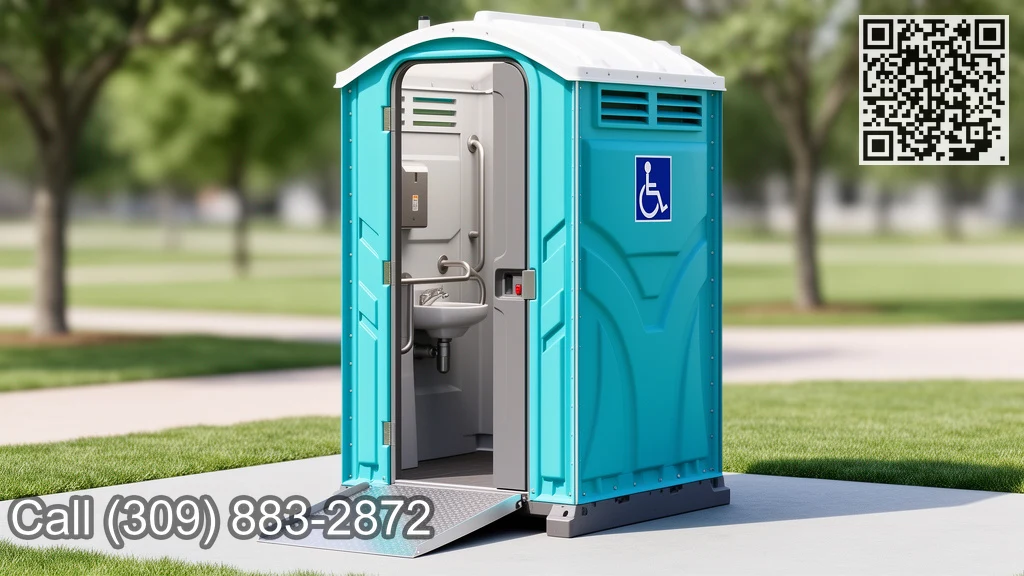
The units need to satisfy the toilet-room technical requirements that use, including transforming space, door navigating clearances, component clearances, and suitable grab bar and water closet clearance guidelines. They additionally must have an easily accessible entry and be linked by an accessible path. If ramps or landings are required, those elements must adhere to the ADA technical requirements too.
That is where event planning comes to be very concrete. You can rent out an ada-compliant portable toilet and still create an unattainable installation by where or how you position it. A certified unit dropped onto soft ground without stable method, or set where the entry can not be gotten to without crossing a rut, curb, or high momentary threshold, is a problem. The same chooses an unit squeezed also close to secure fencing, barriers, energy boxes, or another trailer so the door area no longer supplies useful maneuvering space.
I have actually seen events do almost every little thing right on paper and still stop working in the last ten feet. The rental order consisted of the right ada certified obtainable portable toilets. The vendor delivered them. The icon got on the door. Then another professional shifted the positioning to make room for a food truck queue, and instantly the method tightened and the access experience transformed. Nobody intended to produce an obstacle. It happened since accessibility was treated as a delivery item rather than a site condition that had to be protected.
The join the door issues, yet it is not enough
Accessible portable bathroom systems must be understood the International Sign of Accessibility.
That appears uncomplicated, yet it matters for more than conformity. At a crowded event, people need to be able to locate the right system promptly, without asking team to resolve a basic dignity problem. Clear identification decreases confusion and conserves time.
Still, a significant door does not heal a bad format. I have actually seen visitors roll or walk toward a system with the access sign, just to locate the course obstructed by mud, loosened wire covers, or crowd control fence that was included later on in the day. The tag claimed one thing. The site said another.
That space deserves paying attention to because it is common at momentary occasions. Unlike long-term buildings, event sites change by the hour. Distributions arrive. Generators obtain rearranged. Waste bins overflow right into circulation paths. A crew participant parks a cart in the wrong place for twenty mins, which becomes 2 hours. Accessibility can wander out of conformity even if the original placement was sound.
What event coordinators must validate before visitors arrive
If you are responsible for the washroom plan, there are a few factors that are worthy of a difficult look prior to gates open.
- Count each washroom cluster independently and validate that a minimum of 5 percent of the single-user mobile systems because collection are accessible.
- Make certain every easily accessible system is noted with the International Icon of Accessibility.
- Check the course to the unit, not simply the unit itself, and verify the entryway is accessible.
- If a ramp or landing is part of the setup, verify that it complies with ADA technological requirements.
- Look at the clearance around the door and inside the device with the technological demands in mind, specifically transforming and navigating space.
That is a short checklist, however it catches the blunders I see most often. The first blunder is undercounting because a person considered the entire event rather than the cluster. The 2nd is thinking the vendor alone controls conformity. The 3rd is focusing on shipment and avoiding confirmation after the site has been fully built out.
The course becomes part of the restroom
This point deserves its own interest because it is where numerous great intents fail.
An ada portable restroom does not stand alone. It has to be part of an easily accessible path of travel and have an obtainable entry. That might sound apparent, but momentary occasions are well-known for creating awkward shifts. Crushed rock obtains spread erratically. Short-lived floor covering ends before the restroom zone. An unit is parked simply past a lip or slope that looked safe throughout load-in and really feels difficult when browsing with a wheelchair.
The government criterion does not ask whether a guest can in theory get to the bathroom with aid. It needs an obtainable route and entryway. Those are standard components of usability, not optional extras.
For coordinators, this means the washroom discussion requires to occur early adequate to affect website design. If you wait till the end, you are commonly trying to resolve access with whatever space stays. That usually results in uncomfortable positionings behind stages, close to dumpsters, or beside uneven ground where larger units occur to fit. Already, you are no longer preparing for access. You are improvisating around constraints.
There is additionally a human side to route planning that does not show up well on a site map. People do not experience the event from a bird's-eye sight. They relocate through it in weather condition, groups, noise, and exhaustion. A route that seems acceptable in a silent early morning examination can come to be much harder as soon as lines kind and sightlines vanish. An ada handicap easily accessible portable restroom need to not feel like an unique expedition tucked away from whatever else.
Temporary does not mean exempt
One of the much more persistent misconceptions in occasion operations is that short-term arrangements get even more flexibility due to the fact that they are not irreversible building. In this area, that assumption creates trouble.
The Access Board has specifically indicated that the cluster requirement uses even at short-term events. So if a celebration, fair, concert, community party, or pop-up market is relying upon mobile single-user systems, accessibility is still in play. The fact that the occasion lasts a day or a weekend does not eliminate the standard.
There is one subtlety worth understanding since it comes up in discussions with specialists and website managers. The older 1991 ADA design requirements differentiated mobile bathroom systems at building sites used exclusively by construction workers and spared those from the mentioned portable-toilet accessibility scoping requirement. That is not the exact same thing as claiming portable washroom ease of access does not matter typically. For general https://pristineportablesil.com/privacy-policy/ portable toilet leasings at public-facing occasions, the accessible-unit demand remains.
That distinction is very easy to blur if someone has functioned primarily around building logistics and afterwards applies the same assumptions to a public event. The usage case matters. So does that the facilities are for.
Compliance theoretically versus conformity in the field
There is a distinction in between ordering the appropriate product and delivering an available experience.
An ada certified mobile commode can shed its effectiveness if the lock is tough to operate, if the door swing is obstructed by website clutter, or if the accessible system comes to be the informal household restroom, storage closet, or VIP overflow since it has even more area. The federal standards in the verified context talk with the scoping and technical needs, not to every functional habit that can threaten gain access to. However from an event-management viewpoint, operations still matter.
This is where compassion is more than tone. It is a planning tool.
A guest who requires an available restroom is currently doing psychological math prior to they ask anyone for help. How far is it. Will it be readily available. Will certainly I have adequate area to get in and turn. Will there be a group in front of it. Will a staff member comprehend what I am requesting for. When coordinators treat the ada compliant mobile bathrooms as one line item among several, visitors really feel the difference.
The much better strategy is to assume in regards to integrity. If someone adheres to the indicators to the designated system, can they actually use it without settlement, without rerouting with the rear of house, and without needing a stranger to move challenges out of the way? That is a much more honest examination than simply validating the billing consisted of one ada portable toilet.
Why collection preparation changes the spending plan conversation
The 5 percent guideline at each cluster can impact budget plans in means first-time coordinators do not expect. If you have numerous tiny restroom collections spread throughout a site, the easily accessible count might raise compared to a solitary centralized financial institution. That does not mean the criterion is unjust. It suggests ease of access is tied to just how individuals experience the event, not simply exactly how tools is totaled on a spreadsheet.
I have actually seen teams reply to that fact in two really various ways. One approach is defensive: they deal with every accessible device as a pricey exemption and keep attempting to upgrade around it. The various other method is smarter: they reconsider collection placement, minimize unnecessary fragmentation, and coordinate washroom locations with main flow paths from the start. The second team normally invests more intelligently since they are fixing the ideal issue earlier.
This likewise impacts supplier conversations. If you ask late at the same time for "one ADA unit," you may be requiring a patch. If you clarify the cluster design and ask exactly how to line up the toilet plan with ada mobile bathroom demands, the conversation gets even more practical and less reactive.
The standards rest inside a broader enforcement climate
Accessibility conformity is not fading into the history. If anything, organizations are seeing a broader conformity environment. A current example outside portable restrooms is the Department of Justice assistance on internet and mobile ease of access for state and local governments, with extended deadlines running into 2027 for bigger entities. That assistance is not about short-term event commodes, yet it shows a larger truth: ADA conformity stays energetic, noticeable, and enforceable throughout sectors.
For event coordinators, that more comprehensive climate ought to be a cue to take physical availability seriously rather than treating it as a box to examine. Portable cleanliness might feel like a tiny operational information alongside ticketing, safety and security, or amusement. For the person that can not use the bathroom offered, it is not a small detail at all.
Common judgment calls that deserve genuine attention
Not every event site is neat and degree. Parks, fairgrounds, closed roads, and open areas all introduce restraints. The standards do not vanish when the site obtains untidy, but real-world planning does include judgment. The strongest teams I have actually collaborated with ask harder questions earlier.
They ask whether a cluster must relocate more detailed to a well established accessible course rather than requiring a ramp remedy into a bad area. They ask whether a fenced queue is mosting likely to tighten the method later in the day. They ask who has authority to accept any kind of field adjustments after installation, since "simply shifting the units a little" can reverse conformity quickly.
They likewise recognize that an accessible device needs to not come to be separated. Often a coordinator places the larger system faraway from the main financial institution since it physically fits much better there. On a diagram, that might look efficient. On the ground, it can really feel segregating and troublesome. Accessibility is not just about technical compliance. It is also about equitable participation, which usually implies maintaining the easily accessible choice meaningfully integrated right into the event layout.
Questions worth asking your supplier and site team
A short conversation before delivery can protect against a lengthy day of repairs later.
- How many washroom collections will certainly there be, and the number of accessible units are required in every one to fulfill the 5 percent rule?
- Where will the easily accessible path to every device begin and finish as soon as fence, floor covering, and devices are in place?
- Will any type of ramps or landings be utilized, and if so, who is validating they satisfy ADA technological requirements?
- How will certainly the obtainable systems be recognized on website so visitors can discover them easily?
- Who is accountable for the final area check after all other event elements are installed?
Those questions are illegal movie theater. They are functional safeguards. A lot of availability failures at short-term events do not come from unique technical disagreements. They come from regular control spaces between the restroom vendor, the website crew, and the occasion manager.
What a thoughtful setup looks like
A thoughtful setup is not constantly the fanciest one. It is the one where the accessible washroom strategy was taken into consideration early, set up carefully, and safeguarded throughout the event.
The ada compliant obtainable mobile washrooms are counted effectively within each collection. The units are determined. The course is useful. The entryway works as intended. The door area and indoor clearances are not jeopardized by rash positioning. Team recognize where the units are and do not treat them as storage space or overflow. If site conditions transform, a person checks that accessibility did not transform with them.
That is the type of intending guests rarely notice, which is specifically the point. Excellent access usually really feels average because it gets rid of friction before anybody has to name it. Individuals can merely go to the occasion, enjoy themselves, and use the washroom with dignity.
For coordinators, that need to be the requirement to aim for. Not simply leasing an ada-compliant portable washroom, yet developing a configuration that in fact helps the people who require it. Short-lived occasions are full of moving components. Accessibility should be just one of the pieces that remains steady.
 Ask ChatGPT
 Ask Grok
 Ask Perplexity
 Ask Claude
 Ask Google AI
 Ask You
Ends · TROYWMYH021